Showing posts with label Antigua. Show all posts

Sunday, November 15, 2009

Day 4 - Market and Village Tour - Antigua, Guatemala


On Friday, we started the day with a walk down to the Post Office and wandered through the local market. Very busy on Friday all over Antigua. We heard later there was a large cruise ship in port - but that doesn't account for the locals out in force. Just Friday busyness I guess.

I still don't understand how they balance these baskets on their heads.


These girls are selling fresh fruit. The red, hairy fruit is called rambutan in Southeast Asia. Don't know what it is called in Guatemala.


Makes for a colorful bathroom! We saw similarly colored pilas or Guatemalan sinks on a truck at a building supply store. Most of the units we will see next week are more generic concrete.
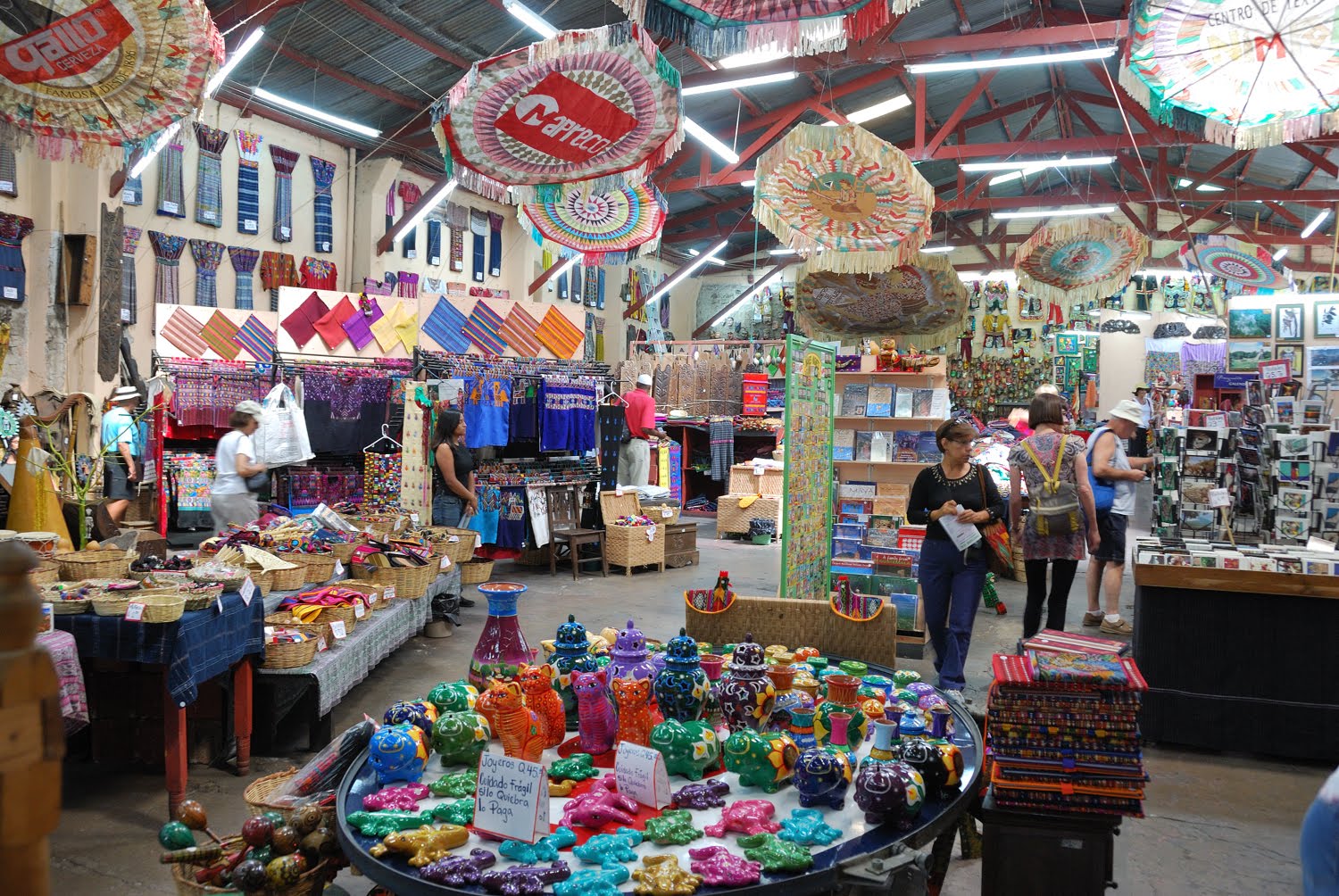


This is a large market in downtown Antigua. All sorts of local handicrafts. I don't think we bought anything here.


These ladies are taking a lunch break. They have been hawking handicrafts on the sidewalk. Apparently this is illegal. They put their wares in their baby carriers whenever a policeman approaches.


In the afternoon we took a tour of several local villages and stopped by several shops producing the local handicrafts. Our first stop was this convent. It is a huge place and was originally the 16th century palace of the first Bishop of Guatemala Fransico Marroquin. It is beautifully restored. We bought some chocolate there. Many of the Bishop's original furnishings are on display.


We asked to go to a jade "factory". Our guide took us down this little street. I was starting to get nervous as we passed the dog going through the garbage in the middle of the street. I skipped a picture of the drunk passed out on the corner. Anyway we knocked on one of the doors and we ended up in a simple shop and sales room.


Very nice people. More reasonable prices than in Antigua. We learned that Guatemalan jade is a different mineral than Chinese jade. Did I mention that in an earlier post?
Jade on Wikipedia


This same village has a community washing center in the town square. The water comes from springs higher up on the volcano. It is reported that a lot of gossip is exchanged here, also. Imagine that.


The village is San Pedro Las Huertas. The washing center is known as Tanque de la Unión. This is the town church opposite the washing center.


From San Pedro we headed to a macadania nut farm. Interesting operation run by an American and his Guatemalan wife. They are promoting it as a solution to typical slash and burn farming. This is the sorting area.


This is the dehusking machine. Pretty basic - a tire and a re-bar chamber. For more information see:
http://www.exvalhalla.net/


Our last stop was a Mayan weaving shop. Here are a couple of shots of the ladies working on their weaving. It is called backstrap weaving. The tension is controlled by leaning against the strap.


It is very fine work. All weaving - no embroidery.

Margot purchased a Christmas themed table runner.


Here is Margot dressed up in a Mayan costume.


Saturday, November 14, 2009

Antigua - Day 3 Finca Filadelfia and Santa Clara Church


On Wednesday morning we got up early to go to a coffee plantation tour. This is a picture of Agua volcano as we wait for the plantation truck to pick us up.


I took this shot of the same volcano from another spot in town as we rode to the plantation.


Here is the truck we rode in on the way to the plantation. It is a Mercedes Unimog. They aren't built for comfort. Very rough ride - but we didn't get stuck in the mud as we drove through the plantation, either.


This is what a coffee bloom looks like. These coffee plants are actually Arabica grafted onto Robusta root stock. The Arabica tastes better and Robusta is more resistant to root diseases. The coffee plants require a lot of pruning over their 20 year useful life. They also like to grow in shade so the shade trees require grooming, also.


There are a lot of steps to producing the coffee. There are about 150 picker families at this farm. Once the fruit is picked the shell is removed and the beans are then washed. There are several sorting steps to grade the coffee. Several of these use flotation in water to grade the coffee. These troughs use flowing water to separate the best grades from the bad beans.


Once the beans are washed and separated they are sun dried on these huge plazas down to 12% moisture.The plazas are sloped so that any rain runs off. The picking season is just starting in this area.


This farm markets their premium beans under the R. Dalton brand. They also sell to Starbucks and other blenders and distributors.


In the afternoon we toured Santa Clara church and convent. This was built in the 1500s and destroyed in the 1773 earthquake.


This is a shot of the garden area.


The former sanctuary. There are several basement areas. Some are used a burial crypts and another as a root cellar.


This is a walkway just outside the sanctuary.


Here is a picture of us overlooking the garden area and other living areas used by the nuns.


That evening while we were out for dinner we took this picture of La Merced church on the main square.


Day 2 in Guatemala - Pacaya Volcano


This is the objective. Actually just over the hump on the right. This picture is from over half way up from the jump off point which was 5 or more miles of bad bumpy road from the highway.


After about 2 minutes of walking up the path we were out of breath and decided to spring for the extra 100 Q each (about $12) to ride up. I've got to say it was the best $24 we have EVER spent. No way I could have made it walking, although a fair number of people did. Margot claims she would have had no problem after all the Curves workouts.


Here are a couple of photos from on the way up. This is a corn field. I understand there was a drought in Guatemala this year and much of the corn crop failed.


This picture is looking back toward Antigua. The volcano on the right is Agua with Fuego on the left. Antigua is just beyond Agua.


This lake is a former caldera.


This is another view of the other volcanos.


Here is Margot heading toward an old lava flow. Click to enlarge and see if you can locate the little specks below the summit and above the old lava flow. Those are people and horses. We are going to drop the horses there and walk the rest of the way. We'll eat lunch at the same spot on the way down.


Here is Margot and our guide walking up through the lava rocks.


Here is the payoff. Lava flowing out and down the mountain. Difficult to get a sense of scale from the picture. This flow is about 10 feet across where we can see the red lava.  A larger area of flowing lava with a crust on it was observed put it didn't photograph well.


Here is Margot walking down. You can see how loose the rock was a this point. Sort of like walking up hill in pea gravel - very tiring. Not too bad going down. You can sort of ski a little with each step.


This is where we stopped for lunch. Quite the garden spot. At least the rocks are cool enough here to sit on them.


This is a geothermal plant on the side of the volcano. It is producing electricity.


This is a little farm on the side of the mountain. The plant in the foreground is called pacaya. I'm not sure which was named first - the plant or the volcano.


Friday, November 13, 2009

First Day in Guatemala


We arrived in Gautemala on Monday afternoon. Uneventful flights. TACA airline service was flawless. They are flying brand new Airbus 319s. We arrived at the hotel after dark. We were greeted by Elizabeth Bell, the owner of the travel service, to make sure check-in went smoothly. It is a house converted into a 5 room hotel. Very nice staff but not much English spoken except for Elizabeth. Here is our room.

Click to enlarge.


Bright and early on Tuesday morning we met Elizabeth and half a dozen other tourists for a 3 hour walking tour of Antigua. A bit of history - Antigua was the third seat of government for the Spanish colonial govenrment in the New World. All of their territory from southern Mexico through most of Central America was governed from here.

The city was founded in 1543. The city was abandoned after an earthqualke in 1773 destroyed much of the city. Consequently not much changed for the next couple of centuries. Much of the original architecture that survived the earthquake remains. It is now a World Heritage site. This is City Hall Palace and the previous picture was the Palace of the Captains General. Both shots are from the plaza in front of the Cathedral below.


This is the main church on the square in the center of the city. It is built in front of the ruins of the original much larger cathedral which was destroyed in 1717.


Here is a shot from inside the church.


Here is a statue of Christ inside the church. It is taken out for processions during Holy Week. It is over 200 years old.


Here is a shot of the ruins of the original Cathedral.


Here is a street scene around town. Cobblestone streets. That is Agua volcano in the background south of town. The 2nd seat of government of the spanish colonies was at the foot of the volcano. It was destroyed by a landslide in 1541 after 17 years of use. After the landslide the capital was moved a few miles to the city of Antigua.


Later we toured the museum and grounds at the Casa Santo Domingo. This is a huge 5 star hotel just a couple of blocks from our hotel. Here are couple of shots from the museum and a few shots from around the grounds.


The skys cleared in the afternoon. This picture is from the front garden of the house were we are staying. The ruin across the street is Concepcion church.


An interesting door I thought. The origianl city is laid in square blocks. Each block contained 4 homes - estates really - with a home, garden and perhaps livestock. Over the years they have been subdivided many times.


Here is a picture of the main square.


This is the fountain in the center of the square. Check out the fountain closely. Seems a little incongruous with the conservative nature of the society.